
Your homepage, side by side with what AI said back
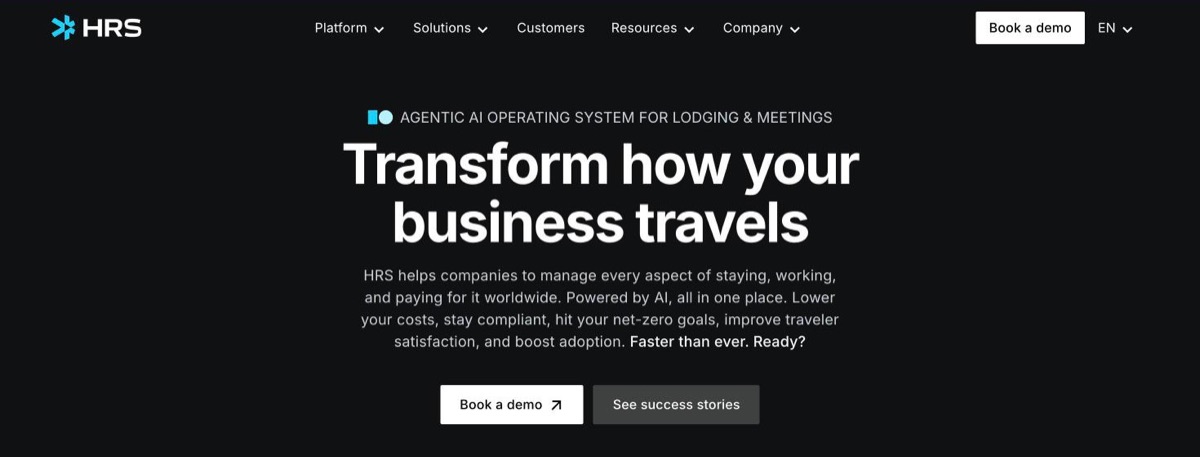
Two stories sit on the same homepage: the operating system in the eyebrow, and the platform that complements what a company already runs in the FAQ. In these answers, the engines repeated the second one.
Question for you: which of your lines would you most want a buyer to hear back from AI?
Asked by name, four engines told it four ways
| Engine | What it said HRS is |
|---|---|
| ChatGPT (web search on) | "A global business travel technology company headquartered in Cologne, Germany." It listed HRS Connect, HRS Copilot, HRS Pay and Green Stay, and said HRS states that "approximately 35% of Fortune 500 companies work with its platform." |
| Google AI Mode (search on) | "A global, AI-powered corporate travel technology company headquartered in Cologne, Germany" that "has evolved from a consumer hotel booking portal into an end-to-end B2B enterprise platform." It named HRS Connect and Copilot, said "roughly 35% to 40% of the Fortune 500" use HRS, named Siemens, PwC, Deutsche Telekom and Sanofi as clients, and also described hrs.com as "one of Europe's top three online hotel portals." |
| Perplexity (search on) | "A Cologne-based travel technology company whose platform helps organizations manage corporate lodging and meetings." For clients it named Google, China Mobile, Alibaba and Panasonic. Its first-listed source was Asana's customer story about HRS (more on that in card 05). |
| Claude (no web) | A Cologne company offering "corporate lodging and travel management solutions", with hotel sourcing and RFP tools, travel payments, meetings, sustainability reporting and duty of care. It named Booking.com for Business, Egencia, SAP Concur and Cvent as competitors. It didn't mention Copilot or Connect. |
One line from ChatGPT is worth keeping: "HRS isn't simply another consumer hotel booking website like Expedia or Booking.com." Whoever asks it gets that distinction drawn for them.
Each engine picked its own proof: ChatGPT the Fortune 500 line, Google a set of named enterprise clients, Perplexity a different set of names from a third-party profile.
Question for you: which proof would you want a buyer to meet first?
"HRS Group (hrs.com) is a global business travel technology company headquartered in Cologne, Germany."
ChatGPT, logged out, web search on, Nov 17, 2026
Asked for the best platforms, all four engines named HRS
| Question: "What are the best corporate lodging and hotel procurement platforms for large enterprises?" | How HRS appeared |
|---|---|
| ChatGPT (web search on) | First: "Best overall for hotel procurement." Then Cvent Transient, SAP Concur, BCD Travel, American Express Global Business Travel and Corpay Lodging. |
| Claude (no web) | Listed under "Dedicated Hotel Procurement/RFP Platforms" next to Cvent and Lanyon, described as specializing in "corporate lodging program management, dynamic pricing, and hotel rate negotiation at scale." SAP Concur, Navan and Amex GBT sat in a different group. |
| Google AI Mode (search on) | First under "Dedicated Hotel Sourcing & RFP Platforms": HRS "excels at global 'Lodging-as-a-Service.'" Its comparison table gave HRS's strength as "Global hotel aggregation, virtual payments, & ESG data," best for "Multinationals consolidating fragmented global hotel spend." Then ReadyBid, Cvent, TRIPBAM, Navan, Amex GBT and SAP Concur. |
| Perplexity (search on) | "I'd start with HRS for end-to-end global lodging procurement." Then Cvent, Amex GBT Consulting, Corpay Lodging and Engine. It also said what sets HRS apart: "it connects supplier negotiations to whether contracted rates are actually available, used, invoiced correctly, and paid through the managed process." |
Four runs aren't a ranking. What they show is that, in these runs, the category slot exists and HRS is in it. Perplexity's sentence is the closest any engine came to saying why HRS, and not just what HRS does.
Question for you: is that the sentence you'd want every engine to say?
Described without the category word, three of four named HRS
"We're a global company with a large annual hotel spend and a lot of bookings made outside our travel program. Which platforms should we evaluate to bring lodging and meetings under control?"
| Engine | What came back |
|---|---|
| ChatGPT (web search on) | HRS first: "strongest fit for lodging and meetings consolidation." Then Cvent, BCD Travel, American Express Global Business Travel and Navan. |
| Claude (no web) | Four categories of tools (travel management companies, hotel-specific platforms, meetings and group housing, integrated expense suites), no named shortlist (Cvent appeared only as a type, "SMM/Cvent-type platforms"), and four questions back to the buyer. |
| Google AI Mode (search on) | Pair "a specialized hotel procurement platform (like HRS or Cvent)" with a booking tool like Navan or Spotnana. It called HRS "the global leader for enterprise lodging programs." Its table rated HRS "Very Strong" on hotel RFPs and "Moderate" on meetings and group blocks, where it called Cvent the "Market Leader." Its suggested path: fix the booking experience first, "and layer HRS underneath if your annual hotel spend exceeds $5M-$10M+." |
| Perplexity (search on) | "I'd put HRS first on your evaluation list," calling it "the closest fit to your combined brief" and naming Connect and Copilot. Then Cvent as the benchmark, and SAP Concur TripLink for visibility into bookings made outside the program. |
So the problem as a buyer describes it leads to HRS when the engine can search. Where the engines differ is the meetings half of the brief: Perplexity read HRS as lodging and meetings together, while Google gave meetings to Cvent.
Question for you: your homepage says "lodging & meetings." Which of these two reads is closer to how buyers see HRS today?
What ChatGPT said each vendor is best for
| Vendor | ChatGPT's one-line role |
|---|---|
| HRS | "Strongest fit for lodging and meetings consolidation" |
| Cvent | "Strongest dedicated meetings management contender" |
| BCD Travel | "Strongest managed travel and meetings ecosystem" |
| American Express Global Business Travel | "Strong global enterprise alternative" |
| Navan | "Strong alternative for booking adoption and policy enforcement" |
In its comparison table, ChatGPT marked HRS "Strong" on all seven capability rows. It marked the others "Strong", "Partial", "Meeting-focused", "Available" or "Evaluate", and added that this was "a qualitative shortlist based on published product capabilities, not a verified feature-by-feature technical assessment."
Question for you: if a buyer comparing five vendors remembers one thing about HRS, is it the one you'd want? A page full of "Strong" doesn't tell them which.
Where the engines got their facts
| Source the engines showed | What it supplied |
|---|---|
| corporate.hrs.com (About, homepage, use-case and team pages) | Most of the product descriptions in both engines' answers, and the Airbus example Perplexity gave as evidence of enterprise scope. |
| HRS's LinkedIn company page | The "over 5,000 corporations" line Google showed beside its answer. |
| Asana's customer story, "A successful digitalization journey with Asana" | Perplexity's first-listed source for "What is HRS Group?" |
| theorg.com company profile | The client names Perplexity gave (Google, China Mobile, Alibaba, Panasonic), from a blurb that says HRS serves "more than 3000 companies." |
| ReadyBid blog posts | The most-cited source in Google's answer to the category question, including next to its description of HRS. ReadyBid appears in that same answer as an alternative. |
| leadiq.com and contactout.com | Listed among Perplexity's sources, where HRS is filed as an "IT Services and IT Consulting" company. |
None of this is unusual. Engines fill gaps with whatever is easiest to find, and it helps to know which pages are doing the talking.
Question for you: is there a page you'd rather the engines were reading?
Asked across the buying journey, the engines meet HRS at the decision
| Stage and question | Google AI Mode | Perplexity | ChatGPT |
|---|---|---|---|
| Problem. "How are large companies using AI to control business travel spend and keep employees booking inside the travel program?" | Not named. Otto, Amex GBT, SAP Concur, Navan, Conferma. | Not named. Navan throughout, then SAP Concur and Amex GBT. | Not named. Navan, SAP Concur, Amex GBT, Traxo. |
| Category. "What are the best agentic AI platforms for managing corporate hotel stays and meetings?" | Not named. "Amex GBT (Egencia / Neo) or Navan ... paired with Groupize." | Named first: "HRS Copilot + Connect, Groupize aime, and Navan." | Not named. Navan, SAP Concur, Egencia, Cvent, Groups360, Spotnana, hivr.ai. |
| Decision. "We're choosing between HRS, Cvent and Navan for our global hotel and meetings program. Which should we pick, and why?" | HRS, "if your primary pain point is taming global hotel spend, automating VAT/invoicing, and consolidating transient lodging with simple-to-mid-sized meetings." | HRS as "the preferred finalist," for consolidating lodging procurement and connecting booking to payment. | HRS as "the lead platform," with Cvent as the strongest alternative for event-heavy programs. |
Your homepage leads with "Agentic AI operating system for lodging & meetings." In these nine answers, the engines described HRS by what it does for hotel spend: sourcing, rate audits, payment, VAT. Perplexity came closest to the newer story. It named Copilot and Connect, and said HRS's distinction is "the connection between procurement decisions and execution."
Three answers is a small sample per stage, and answers change run to run. What it shows is where HRS is already the default and where other names arrive first.
Question for you: which of these three questions matters most to how HRS wins over the next year?
The part only HRS can say
Here's what struck me reading all of this.
Every platform in these answers says AI now. Navan, Amex GBT, SAP Concur, Groupize, the startups. When every vendor sprinkles AI on top, it stops telling a buyer anything. I call it AI Parmesan, and I think that era is over. Buyers are back to asking a simpler question: what will this actually do for my program?
The engines got close to what HRS does. What none of them carried is why.
Why does HRS believe lodging and meetings belong in one operating model, from procurement all the way to reclaim? What does HRS see about where corporate travel is going that the rest of the market doesn't?
That belief is the strategy, and it's the answer every buyer is quietly looking for. Before anyone signs, they're asking themselves three questions: why change, why now, and why HRS? A clear why answers all three. It's the story a buyer repeats to their CFO, and the line we'd want every engine to say back.
From the outside, we can only see the gap. The answer lives inside HRS, with the people who set the direction.
That's where PitchKitchen comes in. We're a messaging-first B2B marketing agency, and we start with the story: we pull the strategy out of the leadership team's heads and write down the why, so your whole team, and every AI, can use it.
Then we build everything on it. The website, the sales presentations, the sales enablement and the marketing creative, so every conversation your team has tells the same true story and moves the deal forward. Then we measure whether buyers and the AI engines repeat it.
It's why I'm looking forward to our conversation. I'd love to hear the why behind HRS in your words.

Greg Rosner
Founder, PitchKitchen
How to check every number
How to check every claim
- Your homepages: corporate.hrs.com (headline "Transform how your business travels", eyebrow "Agentic AI operating system for lodging & meetings") and hrs.com/en, both saved Nov 17, 2026.
- The three questions, asked on Nov 17, 2026: (1) "What is HRS Group (hrs.com) and who uses it?" (2) "What are the best corporate lodging and hotel procurement platforms for large enterprises?" (3) "We're a global company with a large annual hotel spend and a lot of bookings made outside our travel program. Which platforms should we evaluate to bring lodging and meetings under control?"
- Card 06, asked late afternoon (Eastern time) Nov 17, 2026, each in a fresh session: (4) "How are large companies using AI to control business travel spend and keep employees booking inside the travel program?" (5) "What are the best agentic AI platforms for managing corporate hotel stays and meetings?" (6) "We're choosing between HRS, Cvent and Navan for our global hotel and meetings program. Which should we pick, and why?" ChatGPT ran in a temporary chat set to ignore memory and custom instructions. Claude isn't in card 06: the browser session available to us carried our own preferences, so we left it out rather than show a slanted answer.
- Claude: claude-sonnet-5 through Anthropic's API, no web access, so answers come from the model's memory and can be out of date.
- ChatGPT: chatgpt.com, logged out, web search on, in the morning (Eastern time) of Nov 17, 2026. Answers can change run to run.
- Google AI Mode: google.com in Chrome, signed in to a Google account (answers can be lightly personalized), in the afternoon (Eastern time) of Nov 17, 2026.
- Perplexity: perplexity.ai in Chrome, signed in on a free account, default settings, in the afternoon (Eastern time) of Nov 17, 2026. Its sources for each answer are on card 05.
- The 35% Fortune 500 figure is HRS's own claim, quoted by ChatGPT as such. Google's "35% to 40%" and every client name on this page are the engines' words. We haven't verified them.
Where did Claude get it wrong?
You know HRS Group far better than any AI does, and that is the useful part. If you tag a few cards, one click assembles a note you can send to Greg. Nothing leaves your computer unless you send it.